

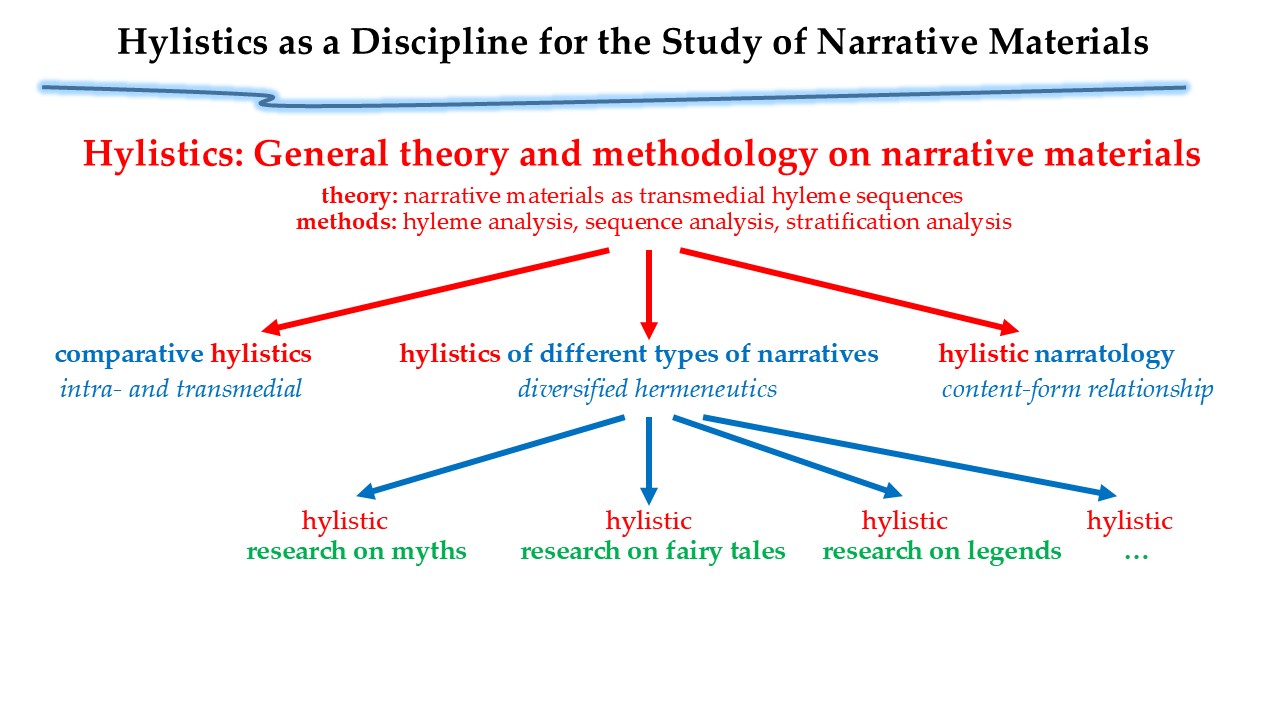
One main scope of hylistics is the study of narrative materials, such as myths (→ LINK def myth): Hylistics helps to define, reconstruct, analyse, and compare narrative materials.
At the core of hylistic theory and methodology are the following observations:
- Narrative materials exist in a transmedial way, i.e. it can be used in different media.
- Narrative materials are characterised by sequences of events that imply change.
This presents the following challenges:
- How can narrative materials as transmedial phenomena be analysed, if they are to be reconstructed from their media concretisations?
- How can changes be described scientifically?
Such a reconstruction and description can be achieved by referring to the minimal state- or action-bearing units of narratives or events in general, the hylemes (→ LINK).
Definition of „narrative material“ or „narrative“ (German: „Erzählstoff“)
Narrative material is an account of changes that can be represented in the form of language and manifest in different medial representations and can be reconstructed in the form of minimal state- or action-bearing units, i.e. hylemes („hylemes“ ® LINK hyleme), as hyleme sequences.
Changes are defined by a combination of states and actions. Every single change of state consists of exactly three hylemes (→ LINK hyleme). First, state A prevails; then at least one factor changes; this change leads to state B:
Change = state A + action, leading to state B.
Therefore an analysis of narrative materials, which is in fact an analysis of changes, consists in an analysis of combinations of states and actions.
As a result, hylistic research functions as ‚content analysis‘ or semantic analysis (→ LINK Hyl and Phil).