

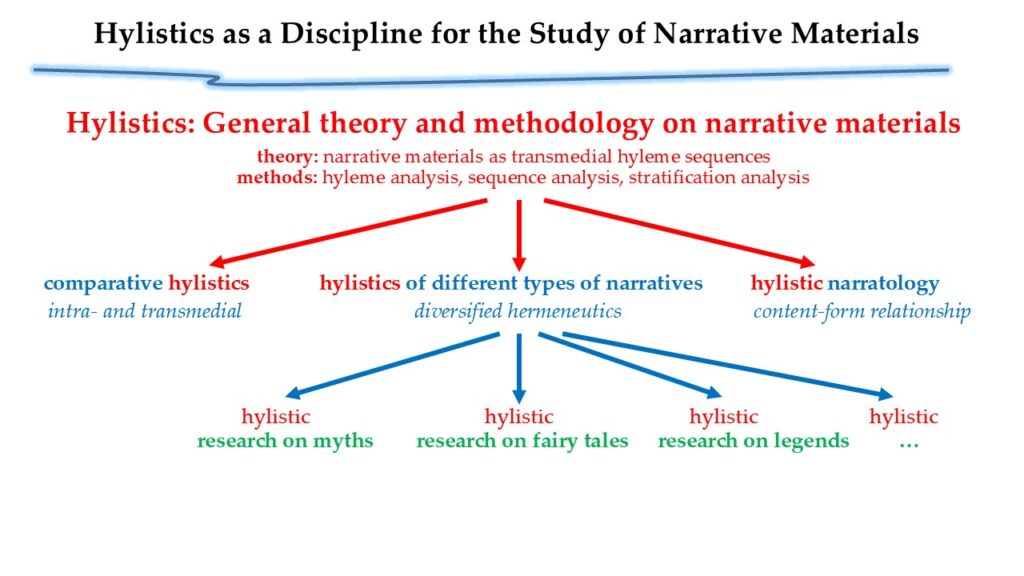
One of the main concerns of hylistics is the study of narrative materials, such as myths. Hylistics helps to define, reconstruct, analyse, and compare narrative materials.
At the core of hylistic theory and methodology are the following observations:
- Narrative materials exist in a transmedial way, i.e. they can be used in different media.
- Narrative materials are characterised by sequences of events that imply change.
Theoretical challenge
This presents the following challenges:
- How can narrative materials as transmedial phenomena be analysed if they are to be reconstructed from their media concretisations?
- How can changes be described scientifically?
Methodological response
Such a reconstruction and description can be achieved by referring to the minimal state- or action-bearing units of narratives or events in general, the hylemes.
1.1. Definition of “narrative material”
Observations
An essential feature not only of mythical narratives but of narrative materials of all kinds (German: Erzählstoffe) is the representation of status changes (Schmid 2007, 98: “Repräsentation von Zustandsveränderungen”; see already Aristotle poet. 6,1450a5 and 6,1450a15: “compilation/ composition of events/ happenings”, σύνθεσις/ σύστασις τῶν πραγμάτων). That is to say that in narratives, on principle, “things are happening”. At least one narrative unit will cause a state A to change to state B.
As a rule, narratives consist of a coherent sequence of several individual state- or action-bearing units, that is units which describe particular deeds, events, occurrences (and states in-between), with a beginning and an end: first one thing happens, then another, then something else, etc., and this happens at the end. Narratives must therefore be separable into a sequence of individual narrative units. These minimal narrative units exist independently of their respective concrete (e.g. textual) form, and consequently we should be able to extract them from their respective manifestation in a specific medium.
Consequences
Narrative material is an account of changes. Changes are defined by a combination of states and actions. Every single change of state consists of exactly three hylemes. First, state A prevails; then at least one factor changes; this change leads to state B:
Change = state A (hyleme 1) + action (hyleme 2), leading to ➔ state B (hyleme 3).
Therefore an analysis of narrative materials, which is in fact an analysis of changes, consists of an analysis of combinations of states and actions.
As a result, hylistic research functions as ‘content analysis’ or semantic analysis.
Definition
Narrative material is a sequence of changes that can be expressed in language and manifest in different medial representations and can be reconstructed in the form of minimal state- or action-bearing units, i.e. hylemes, as hyleme sequences.
Reference: C. Zgoll 2026, 133.
1.2 Important characteristics of narrative materials
1.2.1 Transmediality
Narrative material is
≠ text
≠ image
≠ film etc.
but
= the content underlying the text, image, film, etc.
➔ Narrative material exists in a transmedial way, i.e. it can be used in different media.

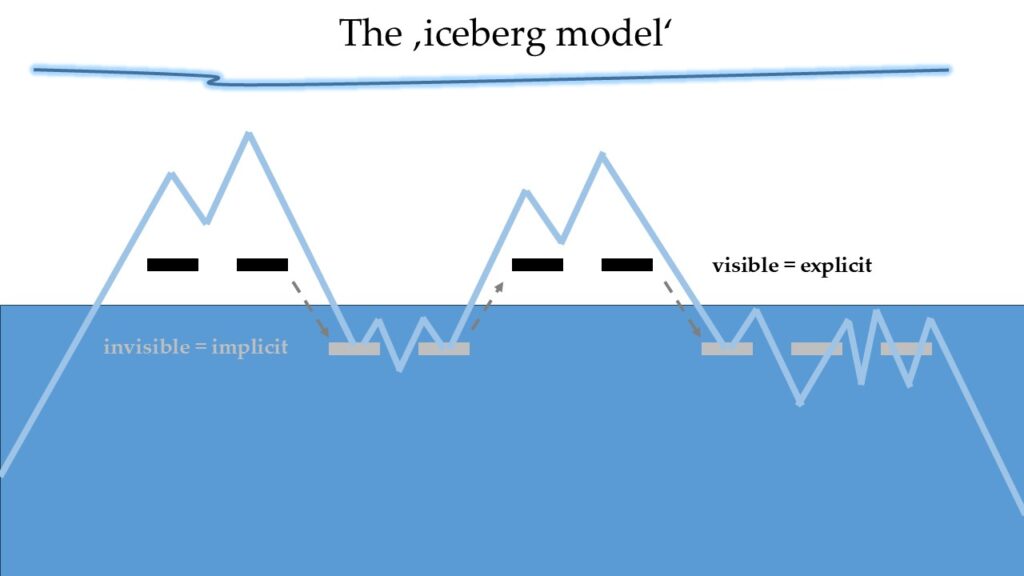
1.2.2 Incompleteness: the ‚iceberg model‘
Any representation of changes in narrative form is incomplete.
➔ ‘Incomplete narration’ is not only the norm, but unavoidable and therefore always the case.
References: Iser 1994; Martínez/ Scheffel 2019, 189; C. Zgoll 2021, 29-35; Schmid 2023
1.2.3 Polymorphy: narrative and narrative variants
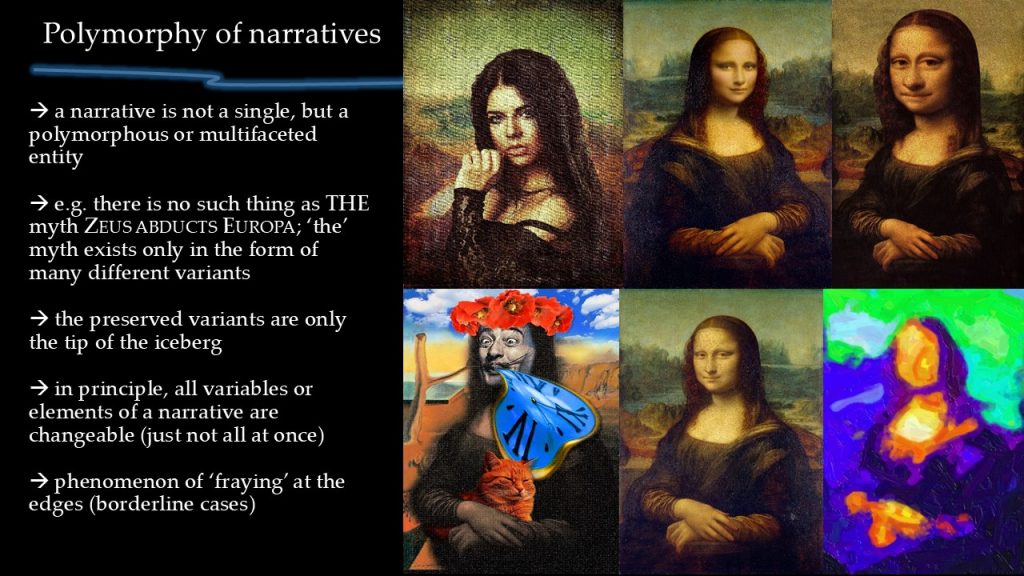
A narrative (material) is a non-finite quantity of currently existing and potentially conceivable variants of hyleme sequences, which can only be circumscribed approximately with regard to specific TTEPP criteria.
A narrative variant is a self-contained sequence of interdependent hylemes of a narrative material which is determined in its details with regard to specific TTEPP criteria.
Example:
Ovid chooses the narrative of the rivalry between the Theban queen Niobe and the goddess Leto, which exists in a wide variety of variants and carries the potential for countless more.
From these variants he then generates a specific, still unformed narrative variant (e.g. one where all of Niobe’s children are killed by Artemis and Apollo, and none are spared).
Through artistic intervention, e.g. the introduction of proleptic allusions to the dreadful ending, this unformednarrative variant becomes a „well“ formed, poetically shaped narrative variant, which is eventually presented in a particular medial manifestation, in our case in textual form, namely in lines 146-312 in Book 6 of Ovid’s Metamorphoses.
narrative: open field of different conceivable variants
⬇
unformed narrative variant: narrative specified with regard to specific TTEPP criteria
⬇
well formed narrative variant: artistically ‚designed‘ narrative variant
⬇
medial manifestation: representation of the well formed narrative variant in a specific form (text, image, film etc.)
Reference: C. Zgoll 2020, 36-38
References:
Iser, W., 1994, Der Akt des Lesens. Theorie ästhetischer Wirkung, 4., durchges. und verb. Aufl., München (1. Aufl. 1976).
Martínez, M./ Scheffel, M., 2019, Einführung in die Erzähltheorie, 11., überarbeitete und aktualisierte Aufl., München.
Schmid, W., 2007, „Erzähltextanalyse“, in: T. Anz (Hg.), Handbuch Literaturwissenschaft. Gegenstände – Konzepte – Institutionen, 3 Bde., Stuttgart, Bd. 2, 98-120.
Schmid, W., 2023, The Nonnarrated, Narratologia – Contributions to Narrative Theory 87, Berlin/ Boston.
Zgoll, C. 2020, Myths as Polymorphous and Polystratic Erzählstoffe: A Theoretical and Methodological Foundation, in: A. Zgoll / C. Zgoll (ed.), Mythische Sphärenwechsel. Methodisch neue Zugänge zu antiken Mythen in Orient und Okzident, Mythological Studies 2, Berlin / Boston, 9-82. (Open Access: https://doi.org/10.1515/9783110652543-002)
Zgoll, C. 2021, Grundlagen der hylistischen Mythosforschung. Hylemanalyse, Stratifikationsanalyse und komparative Analyse von mythischen Erzählstoffen, in: G. Gabriel / B. Kärger / A. Zgoll / C. Zgoll (ed.), Was vom Himmel kommt. Stoffanalytische Zugänge zu antiken Mythen aus Mesopotamien, Ägypten, Griechenland und Rom, Mythological Studies 4, Berlin / Boston, 9-50. (Open Access: https://doi.org/10.1515/9783110743005-002)
Zgoll, C., 2026, „The Unknown Prometheus – and what Hesiod Made of Him. A Case Study of Hylistic Myth Research“, in: M.D. Konaris (Hg.), Studies on Greek Gods and Heroes. Interpretations and Appropriations, Trends in Classics Suppl.-Bd., Berlin/ Boston (forthcoming).