

A precise reconstruction and description of (sequences of) narratives as combinations of states and actions can be achieved by referring to the minimal state- or action-bearing units of such combinations, the hylemes.
2.1 Hyleme: definition, term, and categories
Definition
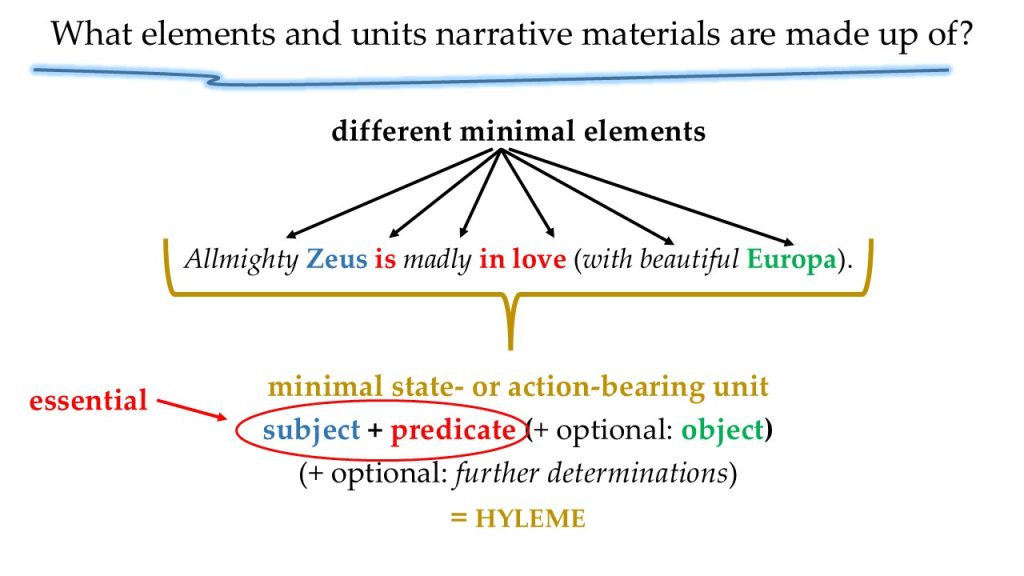
A hyleme is a logically and linguistically standardised, minimal state- or action-bearing unit of a narrative variant.
The terms “hyleme” and “hylistics” are derived from the Ancient Greek word hӯlē (ὕλη), which means „timber, material, fabric“. The term “hýleme” (stress on the first syllable) is analogous to terms such as “morpheme” or “phoneme”, which similarly refer to minimal units which differentiate the meaning in language or sounds.
Two categories of hylemes
In order to provide a complete and precise description of narrative sequences (or sequences of events in general) that imply changes, two ‘classes’ or categories of hylemes are required:
(1) hylemes that describe states, and
(2) hylemes that describe actions.
N.B.
- Hylemes are not tied to specific media, but neither do they exist completely independently of media (e.g. as ‚abstract‘, unchanging entities).
- Hylemes are always concrete, minimal state- or action-bearing units of a specific, medially concretised narrative variant, i.e. not the ‚minimal conceivable units‘, but the minimal in the respective media.
Reference: C. Zgoll 2019, 109-118.
2.2 Narratives as hyleme sequences
Ultimately, all narratives can be broken down into these smallest building blocks, the hylemes, irrespective of the language or media in which the narrative material is presented. In narrative material research (hylistics), hylemes are the ‚atoms‘, the minimal ‚building blocks‘ of not only myths, but all types of narrative materials. Hyleme theory is, in a sense, the ‚atomic theory‘ of narrative material research.
2.3 Standardised form of a hyleme
Linguistically standardised, hylemes are formulated in the present tense and in the active voice, in a simple, non-poetic language and word order (subject – predicate – object).
Example of a description in a poetic text:
„Erechtheus was put out of his life by a thunderbolt from Hera’s powerful spouse.“
This text contains the following hylemes in standardised form (reconstructed parts in brackets):
- [Zeus] is spouse of Hera. // = Hera is the spouse of [Zeus].
- [Zeus] is powerful.
- [Zeus] kills Erechtheus with a thunderbolt.
2.4 Logical structure of a hyleme
The following rules apply to a logically standardised representation of hylemes:
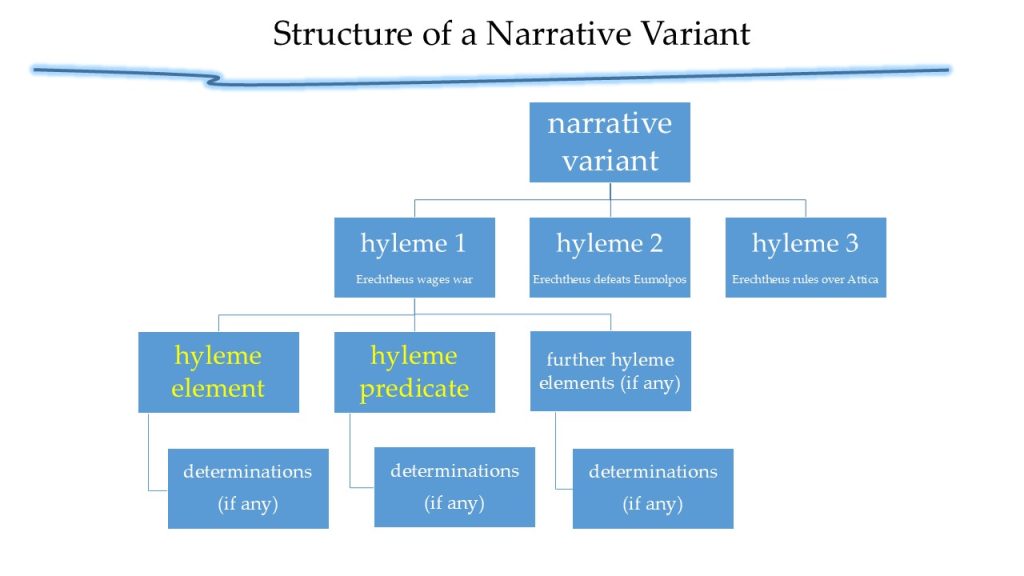
- the logical subject and object positions in a hyleme may be occupied by several subjects or objects (e.g. ‚Prometheus and Hermes steal from Zeus and Hera‘)
- the predicate position, on the other hand, may only ever be occupied by one single predicate; it describes either a single action or a single state (e.g. ‚Prometheus is a child of Iapetos‘: state, or ‚Prometheus steals the fire from Zeus‘: action)
- optionally, all three positions can be further specified by determinations or qualifiers (e.g. ‚The cunning Prometheus steals from the mighty Zeus in a mean way‘)
- figures, objects, locations, phenomena, etc. associated with the hyleme predicate are called hyleme elements.
Hyleme elements and hyleme determinations
In the attempt to divide narratives into their minimal narrative units the intention is not to dissect the narrative or, specifically, a variant of it, into minimal constituting elements (= hyleme elements) such as figures (“Zeus”, “Erechtheus”), actions or occurrences (“slay”), and hyleme determinations such as appositions or characterizations further describing these elements (“mighty”, “king”), or temporal, locational or instrumental information (“in the morning”, “in Athens”, “with a thunderbolt”), but the plane on which individual minimal constituting elements and their determinations are combined into minimal state- or action-bearing units such as “In the morning mighty Zeus in Athens slays the King Erechtheus with a thunderbolt”.
2.5 Hylemes with special functions
With regard to (possible) special functions that individual hylemes may have, a distinction is made between durative hylemes, and hyperhylemes.
Hylemes without a special function do not need a special term.
Durative hylemes
The functions of durative hylemes (which describe a state) vary within a given variant of a narrative material. Therefore a distinction can be made between durative-constant, durative-initial and durative-resultative hylemes.
a) Durative-constant hylemes
Narrative material often contains generalised statements that describe something that remains constant throughout the narrative and can be expressed in hyleme form, such as ‘Zeus is the cloud-gatherer’ or ‘Prometheus is a child of Iapetus’ (cf. Hesiod, Theogony 558 and 568).
Such durative-constant hylemes can, when taken together, especially in longer passages of a text, provide veritable ‘profiles’ of the characters, places or things involved.
b) Durative-initial and durative-resultative hylemes
Often narratives in general and mythical narratives in particular feature durative-initial hylemes, which mark a starting point, in the broadest sense a ‘problem’, and durative-resultative hylemes, which mark the end point of the narrative and a solution to the problem.
Hyperhylemes
Hyperhylemes are hylemes that functionally summarise entire narratives or longer sections in a manner similar to a heading and, in this respect, do not represent a single step within the narrative, but can stand alongside or ‘above’ the narrative (or sections thereof).
For example, a hyleme such as ‘Zeus abducts Europa’ can, in a headline-like manner, summarise several steps of how this abduction is carried out in detail.
N.B.
- Hyperhylemes are often used in the concretisation of a narrative material in texts. In order to understand the meaning of the narrative material and the text itself, it is necessary to recognise these hyperhylemes.
- Hyperhylemes are useful for structuring narrative materials.
- Hyperhylemes are essential when comparing (different variants of) narrative materials.
References: C. Zgoll 2019, 185-204, and 2021, 27 f.
References:
Zgoll, C. 2019, Tractatus mythologicus. Theorie und Methodik zur Erforschung von Mythen als Grundlegung einer allgemeinen, transmedialen und komparatistischen Stoffwissenschaft, Mythological Studies 1, Berlin / Boston. (Open Access: https://doi.org/10.1515/9783110541588)
Zgoll, C. 2021, Grundlagen der hylistischen Mythosforschung. Hylemanalyse, Stratifikationsanalyse und komparative Analyse von mythischen Erzählstoffen, in: G. Gabriel / B. Kärger / A. Zgoll / C. Zgoll (ed.), Was vom Himmel kommt. Stoffanalytische Zugänge zu antiken Mythen aus Mesopotamien, Ägypten, Griechenland und Rom, Mythological Studies 4, Berlin / Boston, 9-50. (Open Access: https://doi.org/10.1515/9783110743005-002)