

Theoretical challenge
Question about the ‘origin’ of ancient myths:
- usually no single ‘author’, at most an ‘editor’ or ‘adaptor’
- sometimes there is evidence, e.g. for the reason behind the creation of a special myth, but this often remains unclear
- usually oral precursors are more than likely, but their reconstruction remains hypothetical
Example: ‘The’ Flood Myth
- Greek Flood Myth of Deucalion
- ‘Precursor’: Hebrew flood myth of Noah
- ‘Precursor’: Akkadian flood myth of Atramḫasīs
- ‘Precursor’: Sumerian flood myth of Ziusudra…
- other ‘precursors’ conceivable
Sharpening of the problem:
Would the assumed original version of a (mythical) narrative really be the original version?
Methodological response
Here, the difference between the following phenomena becomes important:
- concrete hyleme sequence = individual narrative variant
- abstract hyleme sequence = general narrative pattern
Conclusion:
oldest version, e.g. of the Ziusudra flood myth (even if reliably datable):
≠ oldest narrative in which humans are destroyed by a natural disaster (= narrative pattern)
= individual narrative variant
Even the oldest pictorial or textual sources for mythical narratives often originate, relatively speaking, from the ‘postmodern’ era of human storytelling!
4.1 From intertextual references to interhylistic interferences
Universal (and deconstructivist) concept of intertextuality according to Barthes and Kristeva:
- composition of a text from a thousand ‘quotations’ of various origins
- generation not of one meaning of a text by the author, but of an infinite number of meanings by an infinite number of recipients (Barthes: ‘death of the author’)
- later narrowing to text-text references (refined concept of intertextuality in literary studies; overview: Schmitz 2002, 92-99)
Transfer from the realm of texts to the realm of (mythical) narratives:
- radical deconstructivist concept of intertextuality is problematic in relation to texts (the author is not entirely ‘dead’), but unproblematic in relation to mythical narratives in particular, indeed adequate in the true sense of the word
- ancient mythical narratives usually have no individual author (cf. ‘death of the author’) and, due to their long tradition, are a patchwork of elements from a wide variety of sources (importance of stratification analysis)
- analogous narrowing makes sense in terms of mutual interferences or relations especially between narratives (narrative-narrative interferences = interhylistic interferences)
4.2 Interhylistic interferences: Interhylisticity
Important aspects:
- narrative-narrative interferences are not only possible, but it is impossible for there to be no interferences between narratives that come into contact with each other (no narrative arises in a vacuum)
- narrative-narrative interferences are subject to different conditions than text-text references (e.g. the aspect of intentionality)
- reliable evidence of narrative-narrative interferences must be identified (more challenging than in the case of text-text references)
Regarding especially mythical narratives:
- myths are ‘cultural products’; they are in constant dialogue with other cultural factors (religious, political, and social phenomena, artistic views, events, etc.)
- myths as narratives are particularly closely linked to other narratives, especially to other mythical narratives
- it is impossible for myths to arise independently of other mythical narrative patterns and/or of other concrete mythical narrative variants and remain unaffected by them
Definition of interhylistic interferences (interhylisticity):
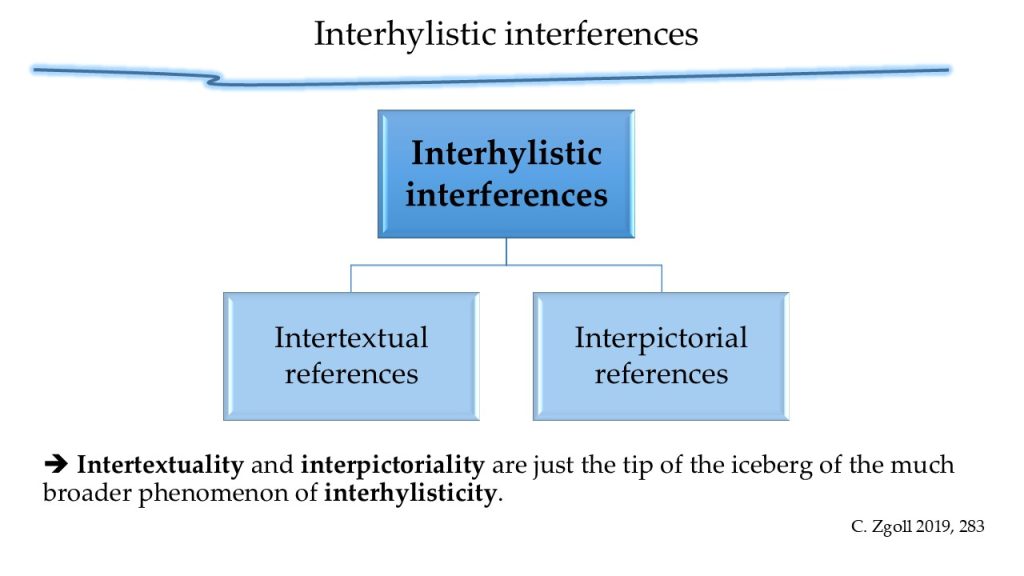
Interhylistic interferences describe the phenomenon of mutually influencing and interfering narratives and the associated interferences of concepts and ideas behind these narratives.
Reference: C. Zgoll 2019, 281
Interhylistic relationship:
= an entirely content-driven relationship between variants of a narrative material or between different narrative materials incorporated in different text(s)
Intertextual relationship:
= a content- and form-driven relationship between the variants of a narrative material or between different narrative materials incorporated in the same or different text(s)
Further reading, with case studies: C. Zgoll 2019, 270-288.
References:
Barthes, R., 1968, „La mort de l’auteur“, in: Manteia 1968, 12-17 (dt. Übersetzung in Jannidis et al., 2000, 185-193: „Der Tod des Autors“).
Kristeva, J., 1967, „Wort, Dialog und Roman bei Bachtin“, in: Ihwe, J. (Hg.), 1972, Literaturwissenschaft und Linguistik. Ergebnisse und Perspektiven, Ars poetica, Texte Bd. 8/III: Zur linguistischen Basis der Literaturwissenschaft II, Frankfurt a. Main, 345-375.
Schmitz, T.A., 2002, Moderne Literaturtheorie und antike Texte. Eine Einführung, Darmstadt (Ndr. 2006).
Zgoll, C. 2019, Tractatus mythologicus. Theorie und Methodik zur Erforschung von Mythen als Grundlegung einer allgemeinen, transmedialen und komparatistischen Stoffwissenschaft, Mythological Studies 1, Berlin / Boston. (Open Access: https://doi.org/10.1515/9783110541588)