

Theoretical challenge
The intra- and transcultural comparison of sources presents major difficulties through
- sources with formal differences, e.g. presenting the same narrative variant in different length, with different formal strategies, etc. (see e.g. the tasks of hylistic narratology)
- sources in different languages
- representation of a narrative in different media
The tasks comprise:
- comparison of narrative variants, intramedial (e.g. texts)
- comparison of narrative variants, transmedial (e.g. texts and images)
- comparison with similar narrative variants in the same culture
- comparison with similar narrative variants in other cultures
Methodological response
Hylistics provides tools for the intra- and transmedial comparison of narrative materials and sources. It is only on this basis that systematic, precise and traceable comparisons become possible. The definition of narrative variants as hyleme sequences enables us, in principle, to render even the most disparate manifestations of one particular variant of a narrative – be they in the shape of a pantomime, film scenes, comic book panels, texts in different languages, reliefs, groups of statues, etc. – in exactly the same, single sequence of hylemes. A crucial foundation has thus been laid for the transmedial and comparative study of (mythical) narratives.
Hylistic comparisons can result in the identification of genetic and typological interhylistic relations, i.e. relations of content.
A subgroup of such relations is the group of intertextual relations, i.e. the relations of content and form.
Further reading: C. Zgoll 2019, 164-204.
6.1 Methodological Steps
Hylistic comparison comprises
- reconstruction and standardisation of hylemes (6.1.1)
- adaptation of hylemes to the same level (6.1.2)
- abstraction of hylemes and hyleme sequences (6.1.3)
- scaling the level of abstraction (6.1.4)
- comparison of number and arrangement of hylemes (6.1.5)
- presenting the outcome (6.1.6)
6.1.1 Reconstruction and standardisation of hylemes
Myths and other narrative materials are not the texts, images or films themselves, but rather the content of these media that first needs to be reconstructed.
Hyleme analysis is the method of reconstructing a narrative sequence in its natural chronological sequence, based on the reconstruction of the minimal state- or action-bearing units, the hylemes, in a standardised way – and standardisation is crucial for making precise methodological comparisons between narratives.
6.1.2 Adaptation of hylemes to the same level
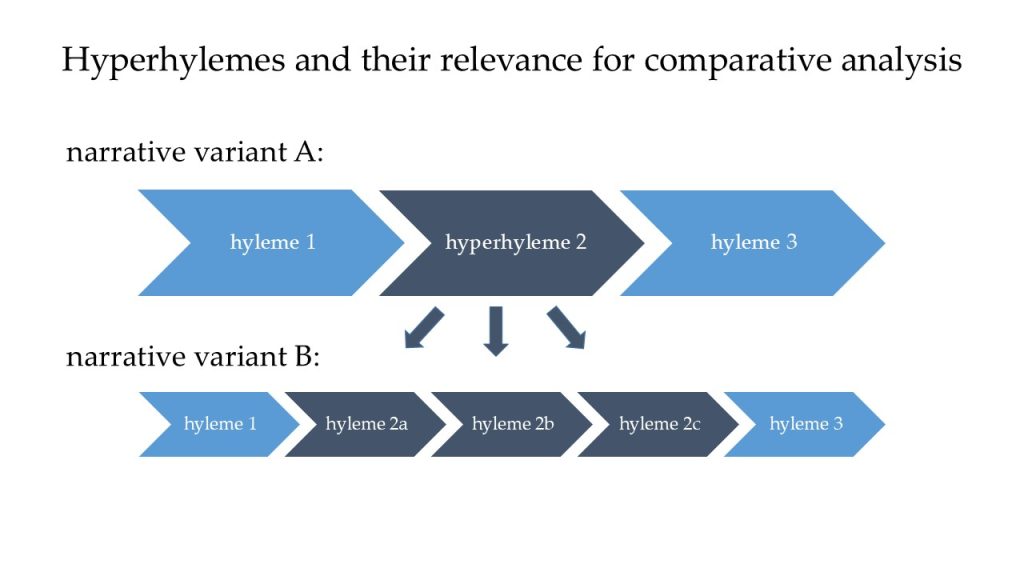
The differentiation of hylemes and hyperhylemes is of vital importance for the comparison of multiple variants of a narrative.
A comparison can present us with different variants of a narrative that appear to run parallel in terms of their broader structure while they differ greatly on the level of the finer details and their degree of elaboration.
For example, a narrative variant A can feature a series of three hylemes, variant B can have five (for the same episode) – a considerable difference in strictly quantitative terms. Upon closer inspection of the content, however, we might find not only the first and the third hyleme from A and B in agreement, but also an equivalent for hyleme No. 2 if and only if we realize that not one, but three hylemes of specimen B merely expand the compressed information from the single hyperhyleme No. 2 of variant A.
In this case, the hyleme sequences would in the overall structure present a much more uniform picture than a casual glance at the purely quantitative differences would reveal.
Reference: C. Zgoll 2020, 41 f.
6.1.3 Abstraction of hylemes and hyleme sequences
Narratives in general, and mythical narratives in particular, are so full of colour and detail, so different and concrete in their locations and protagonists, that in most cases the only way for us to conduct meaningful comparisons will involve certain semantic modifications. Only those modifications will enable us to discover commonalities or parallel structures between narrative variants underneath their differences and specifics. Such semantic interventions will have to refer to an abstraction of existing concretions and specifications.
For the sake of comparison, concrete hylemes and hyperhylemes are abstracted to hyleme- or hyperhyleme-patterns.
Example
| hyleme 1 | hyleme 2 | hyleme pattern |
| Ninurta slays Asag. | Marduk slays Tiāmtu. | God slays deity. |
| Hades abducts Persephone. | Poseidon abducts Amphitrite. | God abducts goddess. |
To refine and sharpen the terminology, we refer to a hyleme (or a hyleme sequence) without proper names for characters or locations, as hyleme pattern (or hyleme sequence pattern, or even shorter, as a narrative pattern); this in contrast to a concrete hyleme (or hyleme sequence), which derives its specificity from the very presence of such determinations.
With regard to myths in particular one must be very cautious when it comes to determining an “oldest form”, which can usually no longer be reconstructed in the case of myths. It becomes particularly difficult when one abstracts from concrete narratives to narrative patterns. In rare cases, it may be possible to reconstruct a “stemma codicum” for myths, but such a stemma is often ultimately only very hypothetical, especially with regard to the transmission, which was mostly oral.
Reference: C. Zgoll 2020, 47-52.
6.1.4 Scaling the level of abstraction
It goes without saying that the inclusion of different degrees of concreteness and determination in hyleme elements, hyleme predicates, and in their determinations (see logical structure of a hyleme) will make comparisons more complex but also more precise and therefore more relevant. The higher the degree of indetermination and abstraction, the higher the number of hylemes or hyleme sequences will be that are likely to have parallels, but the lower will then be the relevance, or significance, of these parallels. To put it another way: the degree of meaningfulness and fruitfulness of any comparison depends on whether we can achieve an appropriate balance between difference, derived from the degree of determination and concreteness, and commonality, based on indetermination and abstraction, between the hylemes or hyleme sequences that are being compared.
Comparisons are fruitful above all if the material is prepared in such a way as to register in the vicinity of a medium degree of determination and concreteness, between the extremes of total abstraction and indetermination on the one hand and an exaggerated concreteness and over-determination on the other. The exact location of the fruitful mean value in each case depends not only on the individual point of departure and the nature of the material but also for instance on the central question(s) that are guiding the comparison.
Reference: C. Zgoll 2020, 46 f.
6.1.5 Comparison of number and arrangement of hylemes
Naturally, in a comparison the similarity between narrative variants gradually decreases to the extent in which additional hylemes are present or absent in a hyleme sequence, or identical or at least similar hylemes are arranged in a different logical or chronological order.
The total number of hylemes also plays a role; the higher the total number of parallel hylemes, the higher we must rate their typological similarity, and the higher will be the probability of a genetic dependency.
Reference: C. Zgoll 2020, 47.
6.1.6 Presenting the outcome: hylistic score
Hylistic score of different versions of one narrative material
A narrative is a polymorphous hyleme sequence, which can be circumscribed only approximately with regard to specific protagonists, places, objects, and events.
A hylistic score (cf. musical score) of different narrative variants can elucidate the interhylistic similarities and differences.
A hylistic score of such versions helps to
- perform and present intramedial or transmedial comparisons of different narrative variants
- approach different options of meaning (and interpretation) of a narrative material
Example: Intramedial (only texts) hylistic score of a myth of Erechtheus

Comparison in the form of a score is a good tool for detecting characteristics of different versions and thus a valuable aid for interpreting the special features of individual variants.
Example: comparison of hylemes 4-6
- Apollodoros: bad – worse – happy end
- Hyginus: happy start – bad – worse
- Euripides: bad – seemingly happy end – tragic end: the ups and downs create a special dramatic situation (historical background: Peloponnesian War!)
Reference: C. Zgoll 2021, 50 f.
6.2 Case Studies
See Publications.
References:
Zgoll, C. 2019, Tractatus mythologicus. Theorie und Methodik zur Erforschung von Mythen als Grundlegung einer allgemeinen, transmedialen und komparatistischen Stoffwissenschaft, Mythological Studies 1, Berlin / Boston. (Open Access: https://doi.org/10.1515/9783110541588)
Zgoll, C. 2020, Myths as Polymorphous and Polystratic Erzählstoffe: A Theoretical and Methodological Foundation, in: A. Zgoll / C. Zgoll (ed.), Mythische Sphärenwechsel. Methodisch neue Zugänge zu antiken Mythen in Orient und Okzident, Mythological Studies 2, Berlin / Boston, 9-82. (Open Access: https://doi.org/10.1515/9783110652543-002)
Zgoll, C. 2021, Grundlagen der hylistischen Mythosforschung. Hylemanalyse, Stratifikationsanalyse und komparative Analyse von mythischen Erzählstoffen, in: G. Gabriel / B. Kärger / A. Zgoll / C. Zgoll (ed.), Was vom Himmel kommt. Stoffanalytische Zugänge zu antiken Mythen aus Mesopotamien, Ägypten, Griechenland und Rom, Mythological Studies 4, Berlin / Boston, 9-50. (Open Access: https://doi.org/10.1515/9783110743005-002)