

A) Hylistics
1 Theory
1.1 The study of narrative materials
1.1.1 Introduction and definition
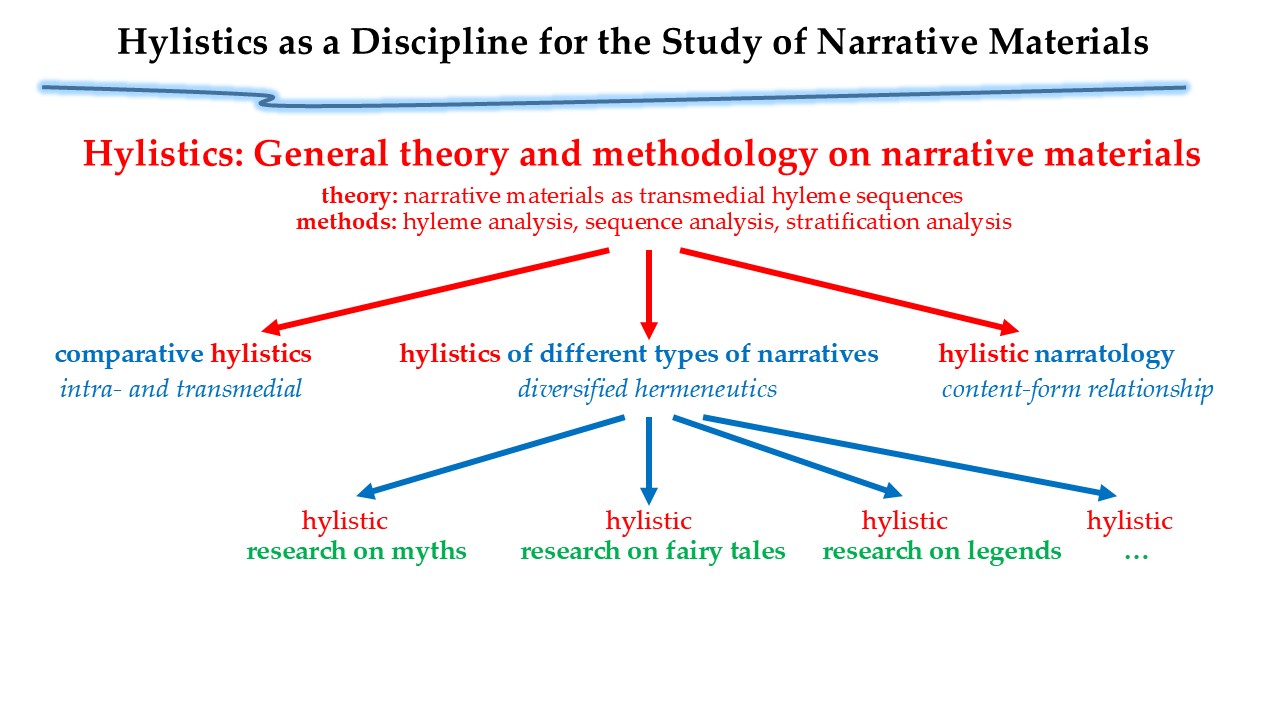
One main scope of hylistics is the study of narrative materials, such as myths (→ LINK def myth): Hylistics helps to define, reconstruct, analyse, and compare narrative materials.
At the core of hylistic theory and methodology are the following observations:
- Narrative materials exist in a transmedial way, i.e. it can be used in different media.
- Narrative materials are characterised by sequences of events that imply change.
This presents the following challenges:
- How can narrative materials as transmedial phenomena be analysed, if they are to be reconstructed from their media concretisations?
- How can changes be described scientifically?
Such a reconstruction and description can be achieved by referring to the minimal state- or action-bearing units of narratives or events in general, the hylemes (→ LINK).
Definition of „narrative material“ or „narrative“ (German: „Erzählstoff“)
Narrative material is an account of changes that can be represented in the form of language and manifest in different medial representations and can be reconstructed in the form of minimal state- or action-bearing units, i.e. hylemes („hylemes“ ® LINK hyleme), as hyleme sequences.
Changes are defined by a combination of states and actions. Every single change of state consists of exactly three hylemes (→ LINK hyleme). First, state A prevails; then at least one factor changes; this change leads to state B:
Change = state A + action, leading to state B.
Therefore an analysis of narrative materials, which is in fact an analysis of changes, consists in an analysis of combinations of states and actions.
As a result, hylistic research functions as ‚content analysis‘ or semantic analysis (→ LINK Hyl and Phil).
1.1.2 Important characteristics of narrative materials
1.1.2.1 Transmediality
Narrative material is
≠ text
≠ image
≠ film etc.
but
= the content underlying the text, image, film, etc.
Narrative material exists in a transmedial way, i.e. it can be used in different media.

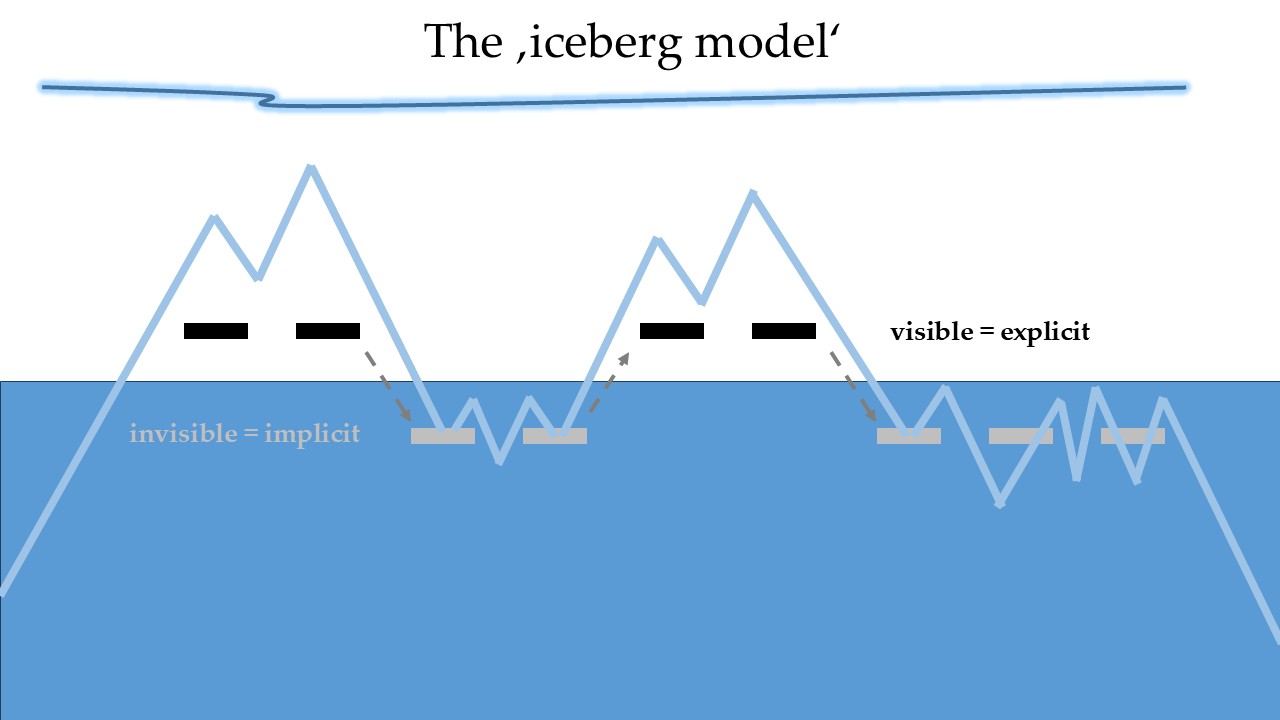
1.1.2.2 Incompleteness: the ‚iceberg model‘
Any representation of changes in narrative form is incomplete.
‚Incomplete narration‘ is not only the norm, but unavoidable and therefore always the case.
References: Iser 1994; Martínez/ Scheffel 2012, 165; C. Zgoll 2021, 29-35
1.1.2.3 Polymorphy: narrative and narrative variants
A narrative (material) is a non-finite quantity of currently existing and potentially conceivable variants of hyleme sequences, which can only be circumscribed approximately with regard to specific TTEPP criteria (LINK TTEPP criteria).
A narrative variant is a self-contained sequence of interdependent hylemes of a narrative material which is determined in its details with regard to specific TTEPP criteria (LINK TTEPP criteria).
Example:
Ovid chooses the narrative of the rivalry between the Theban queen Niobe and the goddess Leto, which exists in a wide variety of variants and carries within it the potential for countless more.
From these variants he then generates a specific, still unformednarrative variant (e.g. one where all of Niobe’s children are killed by Artemis and Apollo, and none are spared).
Through artistic intervention, e.g. the introduction of proleptic allusions to the dreadful ending, this unformednarrative variant becomes a „well“ formed, poetically shaped narrative variant, which is eventually presented in a particular medial manifestation, in our case in textual form, namely in lines 146-312 in Book 6 of Ovid’s Metamorphoses.
narrative: open field of different conceivable variants
¯
unformed narrative variant: narrative specified with regard to specific TTEPP criteria (LINK TTEPP criteria)
¯
well formed narrative variant: artistically ‚designed‘ narrative variant
¯
medial manifestation: representation of the well formed narrative variant in a specific form (text, image, film etc.)
Reference: C. Zgoll 2020, 36-38
1.1.3 Narrative materials as hyleme sequences
A precise reconstruction and description of (sequences of) narratives as combinations of states and actions can be achieved by referring to the minimal state- or action-bearing units of such combinations, the hylemes (→ LINK).
1.1.3.1 Hyleme: definition, term, and categories
A hyleme is a logically and linguistically standardised, minimal state- or action-bearing unit of a narrative variant.
In order to provide a complete and precise description of narrative sequences (or sequences of events in general) that imply changes, two ‚classes‘ or categories of hylemes are required:
(1) hylemes that describe states, and
(2) hylemes that describe actions.
The terms „hyleme“ and „hylistics“ are derived from the Ancient Greek word hӯlē (ὕλη), which means „timber, material, fabric“. The term „hýleme“ (stress on the first syllable) is analogous to terms such as „morpheme“ or „phoneme“, which similarily refer to minimal units which differentiate the meaning in language or sounds.
Reference: C. Zgoll 2019, 109-118.
In narrative material research (hylistics), hylemes are the ‚atoms‘, the minimal ‚building blocks‘ of not only myths, but all types of narrative materials. Hyleme theory is, in a sense, the ‚atomic theory‘ of narrative material research.
N.B.
- Hylemes are not tied to specific media, but neither do they exist completely independently of media (e.g. as ‚abstract‘, unchanging entities).
- Hylemes are always concrete, minimal state- or action-bearing units of a specific, medially concretised narrative variant, i.e. not the ‚minimal conceivable units‘, but the minimal in the respective medial concretisation.
1.1.3.2 Standardised form of a hyleme
Linguistically standardised, hylemes are formulated in the present tense and in the active voice, in a simple, non-poetic language and order of words (subject – predicate – object).
Example of a description in a poetic text:
„Erechtheus was put out of his life by a thunderbolt from Hera’s powerful spouse.“
This text contains the following hylemes in standardised form (reconstructed parts in brackets):
[Zeus] is spouse of Hera. // = Hera is the spouse of [Zeus].
[Zeus] is powerful.
[Zeus] kills Erechtheus with a thunderbolt.
1.1.3.3 Logical structure of a hyleme
The following rules apply to a logically standardised representation of hylemes:
- the logical subject and object positions in a hyleme may be occupied by several subjects or objects (e.g. ‚Prometheus and Hermes steal from Zeus and Hera‘)
- the predicate position, on the other hand, may only ever be occupied by one single predicate; it describes either a single action or a single state (e.g. ‚Prometheus is a child of Iapetos‘: state, or ‚Prometheus steals the fire from Zeus‘: action)
- optionally, all three positions can be further specified by determinations or qualifiers (e.g. ‚The cunning Prometheus steals from the mighty Zeus in a mean way‘)
- figures, objects, locations, phenomena, etc. associated with the hyleme predicate are called hyleme elements.
1.1.3.4 Hylemes with special functions
With regard to (possible) special functions that individual hylemes may have, a distinction is made between durative hylemes, and hyperhylemes.
Hylemes without a special function do not need a special term.
Durative hylemes
The functions of durative hylems (which describe a state) vary within a given variant of a narrative material. Therefore a distinction can be made between durative-constant, durative-initial and durative-resultative hylemes.
Durative-constant hylemes
Narrative material often contains generalised statements that describe something that remains constant throughout the narrative and can be expressed in hyleme form, such as ‚Zeus is the cloud-gatherer‘ or ‚Prometheus is a child of Iapetus‘ (cf. Hes. Theog. 558.568).
Such durative-constant hylemes can, when taken together, especially in longer passages of a text, provide veritable ‚profiles‘ of the characters, places or things involved.
Durative-initial and durative-resultative hylemes
Often narratives in general and mythical narratives in particular feature durative-initial hylemes, which mark a starting point, in the broadest sense a ‚problem‘, and durative-resultative hylemes, which mark the end point of the narrative and a solution to the problem.
Hyperhylemes
Hyperhylemes are hylemes that functionally summarise entire narratives or longer sections in a manner similar to a heading and, in this respect, do not represent a single step within the narrative, but can stand alongside or ‚above‘ the narrative (or sections thereof).
For example, a hyleme such as ‚Zeus abducts Europa‘ can, in a headline-like manner, summarise several steps of how this abduction is carried out in detail.
N.B.
- Hyperhylemes are often used in the concretisation of a narrative material in texts. In order to understand the meaning of the narrative material and the text itself, it is necessary to recognise them.
- Hyperhylemes are useful for structuring narrative materials.
- Hyperhylemes are essential when comparing (different variants of) narrative materials. (→ LINK comparative analysis)
References: C. Zgoll 2019, 185-204, and 2021, 27 f.
1.1.4 Different categories of narrative materials
There exist different categories of narrative materials, e.g.
- myths
- fairy tales
- sagas/ legends
- historical narratives
Criteria to differentiate narrative materials
Different types of narrative material can be distinguished by the use of the TTEPP criteria (German: ZOPHT-Kriterien) (→ LINK zu Sequence analysis): Time, Topic, Events, Places, Protagonists (German: Zeit, Ort, Protagonisten, Handlung, Thematik).
Most helpful for distinguishing between different narrative materials is the criterion of main protagonists. Main protagonists in
- Myths: specific deities and specific humans who are difficult or impossible to verify historically
- Fairy tales: unspecific humans who cannot be verified historically
- Sagas/ Legends: specific humans who are difficult to verify historically
- Historical Narratives: specific humans who can be verified historically
Reference: C. Zgoll 2019, 212-219 (with further criteria)
1.1.5 Comparison of narrative materials
Hylistics provides tools for the intra- and transmedial comparison of narrative materials (and their sources). It is only on this basis that systematic, precise and traceable comparisons between transmedial narrative sequences become possible (→ LINK comparative analysis).
1.2 The study of sequences of events
1.2.1 Introduction and definition
An event is a sequence of changes that can be represented in the form of language and can be analysed in the form of minimal state- or action-bearing units, i.e. hylemes (LINK hyleme), as hyleme sequences.
Analysis of events = analysis of changes:
Every event (→ LINK event) in nature, every technical sequence or process, but also every narrative sequence describing such events, is composed of individual steps that imply changes: first A happens, then B, then C, and so on.
Changes are defined by a combination of states and actions. Every single change of state consists of exactly three hylemes (→ LINK hyleme). First, state A prevails; then at least one factor changes; this change leads to state B:
Change = state A + action, leading to state B.
Therefore an analysis of events, which is in fact an analysis of changes, consists in an analysis of combinations of states and actions.
1.2.2 Analysis of events
A precise reconstruction and description of (sequences of) events as combinations of states and actions can be achieved by referring to the minimal state- or action-bearing units of such combinations, the hylemes (→ LINK).
In order to provide a complete and precise description of sequences of events that imply changes, two ‚classes‘ of hylemes are required:
(1) hylemes that describe states, and
(2) hylemes that describe actions.
Example for a sequence of events:
After reading pages 110 to 120 of the book, Lian closes the book again and put it back on the table.
Analysis 1: Incomplete and imprecise analysis of the sequence of events (= only a paraphrase of the text)
- Lian reads the book from page 110 to page 120.
- Lian closes the book.
- Lian puts the book back on the table.
Problems:
- no consideration of implicit hylemes
- no consideration of state-bearing hylemes
For the method of reconstruction see: hyleme analysis (LINK)
Analysis 2: Complete and precise analysis of the sequence of events (state-bearing units in italics)
- The book is lying closed on the table.
- Lian takes the book from the table.
- Lian holds the book (in her hands).
- Lian opens the book.
- The book is open.
- Lian turns to page 110.
- Lian is on page 110.
- Lian reads up to page 120.
- Lian is on page 120.
- Lian closes the book again.
- The book is closed.
- Lian puts the book back on the table.
- The book is on the table.
2 Methodology
2.1 Overview: Methodological steps of Hylistics
Methods developed for the reconstruction and analysis of sequences of events in general and especially of narrative sequences from their different medial conretisations build the ground for analyzing myths and other narrative materials (or sequences of events in general).
The main methods for hylistic research are:
- Hyleme analysis = reconstruction of the ‘building blocks’ (= hylemes) of a narrative variant (or of a sequence of events)
- Sequence analysis = demarcation and determination of the completeness of narrative materials (or of sequences of events)
- Stratification analysis = analysis of detectable strata per narrative variant (or per sequence of events)
- Media analysis = interpretation of intention and way of representation of the medial concretisation of a narrative variant (or of a sequence of events)
- Comparative analysis (optional) = comparison of reconstructed narrative variants (or of sequences of events)
Interpreting myths depends on these methods, which form the prerequisite and foundation for the task.

2.2 Hyleme analysis
2.2.1 Introduction and definition
Theoretical challenge
- myth and other narrative materials are not texts, images, films etc., but the content of these media
- this content cannot be achieved by traditional philological, archaeological, or other well established methods, since they refer to texts, images or other media
- a distinct methodology is required
(see C. Zgoll 2019 … with reference to …)
Methodological response
Hyleme analysis = Method of reconstructing
- a narrative sequence (= narrower definition of hyleme analysis) or
- a sequence of events in general (= broader definition of hyleme analysis)
in its natural chronological sequence, based on the reconstruction of the minimal state- or action-bearing units, the hylemes (→ LINK).
The profitable use of hyleme analysis requires culture-specific expertise, such as knowledge of language, culture, archaeology and history, etc.
2.2.2 Methodological steps
Theoretical challenge
How are narrative sequences to be reconstructed from their different media concretisations?
Methodological response
Reconstruction in form of the ‘minimal state- or action-bearing units’, i. e. hylemes (LINK) that form the concrete variant of a narrative sequence (or a sequence of events). Especially challenging is the reconstruction of incomplete, of allusively or figuratively expressed and of implicit hylemes.
The method is demonstrated using narrative materials. It can be applied to sequences of events in general in the same way.
Overview of hyleme analysis: Analytical steps
- Completion and clarification of hylemes
- Reconstruction of implicit hylemes
- Standardisation of hylemes
- (Re-)Positioning of hylemes in their chronological order
2.2.2.1 Completion and clarification of hylemes
Theoretical challenge
(a) Which hylemes (or hyleme elements) are only hinted at briefly or formulated elliptically?
(b) Which hylemes (or hyleme elements) are referred to by figurative language or metaphorical expressions?
Methodological response
(a) Completion of allusions or elliptical formulations:
Example with allusion:
“Foundation of Thebes”
Hyleme: NN founds Thebes.
If the context refers to Kadmos as the founder: Kadmos founds Thebes.
Example with elliptical formulation:
„Chryse of Pallas“
in ancient Greek texts the expression „Chryse of Pallas“ is a typical elliptical expression for „Chryse, (the daughter) of Pallas“
Hyleme: Chryse is the daughter of Pallas.
(b) Clarification of figurative (poetic) expressions:
Hyleme analysis is especially important for breaking down and clarifying the meaning of a text that is formulated in a very ‚poetic‘ way.
Example:
„Achilleus bites the dust.“
Hyleme: Achilleus dies.
N.B.: When polysemy is intended, different meanings can be expressed by different hylemes.
2.2.2.2 Reconstruction of implicit hylemes
Any representation of events in narrative form is incomplete. (→ LINK narrative materials)
Therefore, recipients must always supplement narratives; most of this is done unconsciously.
Methodological response
Hylemes are able to represent missing information that is clearly implied but not explicitly represented.
It is necessary to derive such hylemes to make the otherwise unconscious and opaque ideas and decisions about the missing information (or, for the lack of decisions, the missing of the point) conscious and transparent.
In this respect, hyleme analysis is analogous to grammatical (morpheme) analysis (→ LINK sub Hylistics and Philology).
N.B.: Hylemes which are to be supplemented implicitly are the rule, not the exception. Therefore the reconstruction of implicit hylemes is not only an important but an essential part of hyleme analysis.
For the sake of methodological precision, everything that is implicitly inferred but not visible in a text (or in an image etc.) is marked for clarification in the hyleme analysis, e.g. in italics, in grey or in brackets.
Examples:
“Oidipus goes back to Thebes.”
This implies that Oidipus was in Thebes before and left it for a certain reason; after completion of his undertaking, he returns. So there are at least three implicit hylemes to reconstruct:
- [Oidipus is in Thebes.]
- [Oidipus leaves Thebes because of X.]
- [Oidipus does X.]
- Oidipus goes back to Thebes.
Leaving Thebes implies going to another place; so there are more implicit hylemes to be added:
- [Oidipus is in Thebes.]
- [Oidipus leaves Thebes because of X.]
- [Oidipus goes to place Y.]
- [Oidipus does X.]
- [Oidipus leaves place Y.]
- Oidipus goes back to Thebes.
Often in general statements of kinship or verbs of movement implicit hylemes are to be reconstructed (statements with ‘double meaning’).
The relationship from A to B corresponds to the relationship from B to A:
„Chryse is the daughter of Pallas.“
This implies at the same time: [Pallas is the father of Chryse.]
Moving away from starting point A always implies moving closer to destination B, and vice versa:
“Heracles leads Theseus up from the netherworld.”
This implies at the same time: [Heracles leads Theseus to the upper world.]
The scale of implicit hylemes
- logically compelling
- Oidipus leaves Thebes. Oidipus is previously in Thebes.
- of high plausibility
- Antigone calls Oidipus „father“. Oidipus is the father of Antigone.
- of middle plausibility
- Oidipus lies in his bed. Oidipus sleeps.
- possible
- Oidipus marries Iokaste. Oidipus is happy.
2.2.2.3 Standardisation of hylemes
Theoretical challenge
- How can the content of narrative sequences in different media be reconstructed in a methodologically sound, simple and reproducible way?
- How can narrative sequences realised in different media be made comparable?
Methodological response
Representation of hylemes in a standardized form (→ LINK).
2.2.2.4 (Re-)Positioning of hylemes in their chronological order
Theoretical challenge
Narrative material is often presented in different media in a non-chronological way (e.g. through prolepses and analepses, repetitions, etc.).
Methodological response
Restoring the logical-chronological order of the reconstructed (see previous methodological steps) hylemes.
2.2.3 Tasks and benefits of hyleme analysis
2.2.3.1 The tasks of hyleme analysis
When applied to narrative material → clarification of the semantics of a text or image (or other media).
(narrower definition of hyleme analysis)
When applied to sequences of events in general → clarification of the successive ‘steps’ of an event.
(broader definition of hyleme analysis)
These tasks are complex:
As a rule: Several revisions and adjustments are necessary.
In particularly complex or difficult cases, it is useful and important for comprehensibility to explain the reasons for reconstructing hylemes, especially implicit hylemes, in the form of a „hylistic commentary“ – similar to how text editions in philology often provide a philological commentary for the constitution and explanation of a text.
2.2.3.2 Hyleme analysis vs. text paraphrase or image description
Hyleme analysis
- is no text paraphrase
- is no image description
- but the semantic analysis for the reconstruction and understanding of (a variant of) a narrative (or the analysis for the reconstruction of an event)
Hyleme analysis is the method for reconstructing narratives which are in or behind their medial concretisations such as texts, images etc.
Text paraphrase or image description
= normally restricted to explicit information in a text or an image
Hyleme analysis
= formal reconstruction and semantic clarification of explicit and implicit informations in different media
2.2.3.3 Hyleme analysis and interpretation
Hyleme analysis is not an end in itself, but a necessary instrument and precondition for the interpretation.
When applied to narrative materials:
Hyleme analysis
- is applied in an iterative process with philology (→ LINK ad Hyl und Phil; ggf. auch dorthin stellen)
- continues where purely philological and literary analysis of texts ends
Hyleme analysis examines
- not only the ‘visible’ content of a text, image etc.
- but the comprehensive content as fundament for comprehension
2.2.4 Case Studies
LINKs auf verschiedene Anwendungsbeispiele (Erzählstoffe in Texten und/oder Bildern, Rituale …)
Text- und Bild-Hylemanalyse CZ auf Deutsch
2.3 Sequence analysis
2.3.1 Introduction and definition
Theoretical challenge
Texts and other media often combine different narrative materials, often only parts of narrative materials.
- Texts and other media do not contain narrative materials (→ LINK narr mat), but only concrete variants of narrative materials.
- Texts and other media usually contain only parts of concrete variants of narrative materials.
- Texts and other media often combine (parts of) different variantsof narrative materials in a variety of complex ways (→ LINK Hyl. Narr.).
How can individual concrete variants of narrative materials be distinguished from one another?
How can such a variant be checked for completeness?
Methodological response
Sequence analysis = demarcation and determination of the completeness of narrative materials (or of sequences of events in general).
2.3.2 Methodological steps
Sequence analysis disentangles the different narrative materials as distinct hyleme sequences.
First step = Analysis of boundaries of one (variant of a) narrative material (or a sequence of events) by determination of the beginnings and ends.
Second step = Analysis of the completeness of one (variant of a) narrative material (or a sequence of events).
2.3.2.1 Step 1: Analysis of boundaries (TTEPP-criteria)
Illustrated by examples from myths = mythological narratives.
Preliminary considerations of sequence analysis, step 1
Mythical text or mythical image = manifestation of a variant of a myth.
Mythical texts, images, etc. contain different ‘packages’ of narrative materials:
- One text/ image = one (part of a) variant of a myth
- One text/ image = several (parts of) variants of a myth or of different myths or of myths and other narrative materials
First step = Analysis of where onenarrative variant ends and another begins
A narrative variant can be said to be ’self-contained‘ or ‚independent‘ when it displays uniformity with reference to the following TTEPP-Criteria:
- Themes: What is it about?
- Time: When?
- Events: What happens?
- Protagonists: Who?
- Places: Where?
in German ZOPHT-Kriterien:
- Zeit
- Ort
- Protagonisten
- Handlung
- Thematik
Reference: C. Zgoll 2021, 35 f
Individual criteria may need to be weighted differently.
The greater and clearer the difference in these criteria, the more reasonable it is to assume different (variants of) narrative materials (or different sequences of events) are involved.
N.B.: In texts, variants of narrative materials can belong to different categories of narrative materials (for differentiation ® LINK “Categories of narrative materials”); for example, a text may first tell the variant of a myth, then the variant of a fairy tale.
2.3.2.2 Step 2: Analysis of completeness
Illustrated by examples from myths = mythological narratives.
Theoretical basics for the sequence analysis of myths based on myth theory
- Myths deal with something considered significant.
- Myths deal with a specific problem related to this significance.
- Myths tell of how the problem is dealt with.
- The involvement of gods/numinous entities is essential for mythical narratives.
- Myths always end with a solution to the problem. (→ LINK Mythos Characteristics)
Myths do not end in aporia.
Myths serve to explain and cope with the world and its challenges and problems.
N.B.:
- even a seemingly ‘bad’ ending can be a solution to a problem or an explanation
- this depends on the perspective (theocentric vs. anthropocentric)
- when a mythical text appears to end badly, the ending of the text is not necessarily the end of the myth (or: the narrative material is not mythic)
Second step = Analysis of the completeness of the narrative variant
Illustrated by examples from myths = mythological narratives.
Check the following criteria:
- identify the three obligatory parts: problem – dealing with problem – solution (→ LINK Myth characteristics) = especially important in myths, but also in many other narrative materials (e.g. fairy tales, legends, etc.)
- clarify the solution by determining resultative hylemes which function as borderline-markers (often not explicitly stated!)
- compare with other narrative variants of the same narrative material (to be applied with care since narrative variants can differ immensly)
- compare with variants of other narrative materials, which are structurally or thematically similar (to be applied with even greater care)
2.3.3 Case Studies
LINKs auf verschiedene Anwendungsbeispiele (Erzählstoffe in Texten und/oder Bildern, Rituale …)
2.4 Stratification analysis
2.4.1 Introduction and definition
Illustrated by examples from myths = mythological narratives.
Theoretical challenge
How to deal with inhomogenities and inconsistencies which often occur in mythical narratives?
Methodological response
Stratification analysis = Method for identifying and reconstructing different ‘strata’ in a variant of a (mythical) narrative (or in a sequence of events in general).
Stratification analysis is a fundamental prerequisite for semantic, functional, or historical interpretations and classification efforts of mythical narratives.
2.4.2 Methodological steps
2.4.2.1 Analysis of inconsistencies
Explanation of the origin of inconsistencies in mythical narratives based on myth theory
Religious significance + cultural valence + long tradition of mythical narratives lead to
- the polystratic nature of every myth variant, consisting in a combination of different layers (→ LINK Myth Characteristics)
- Different layers lead to
- inhomogenities and even inconsistencies within specific variants of mythical narratives
Methodological step
Identifying inhomogenities and inconsistencies in mythical narratives with the help of the TTEPP-criteria (LINK TTEPP).
The more strange things that seem out of place in a narrative (or event), the more reasonable it is to assume influences from different traditions, creating different layers in a mythical narrative.
2.4.2.2 Analysis of traces of value judgements and hierarchical relationships
Explanation of the origin of value judgements and the creation of hierarchical relationships in mythical narratives based on myth theory
A myth is a narrative material „with an implicit claim to relevance for the interpretation and mastering of the human condition.“ (C. Zgoll 2020, 75-6)
Myth = relevant must fit to people’s worldview
Change of worldview people adapt mythical narratives
Main cause of change: power conflict, (new) hierarchy of the gods
This leads to (new) value judgements and definition of (new) hierarchical relationships in mythical narratives, resulting from power struggles over the authority of interpretation.
Methodological step
Identifying techniques and strategies of value judgements and hierarchical relationships in mythical narratives.
Examples:
- fights, resulting in winner and looser
- change of possession, e.g. through gifting, inheritance, theft, etc.
- creation of (hierarchic) relations between protagonists, e.g. through inthronisation, marriage, birth etc.
- Replacement/substitution of a character
- ‘Retirement’ of a character
- Degradation of a character
- evaluating determinations
- etc.
C. Zgoll 2019, 448-500
2.4.2.3 Analysis of traces of interhylistic interferences
Explanation of the origin of interhylistic interferences in mythical narratives based on myth theory
- The polystratic nature of every myth variant, i.e. the combination of different layers is sometimes due to the influences or interferences of other variants of the same or of other narrative materials.
- Definition of interhylistic interferences = The phenomenon of narrative materials and the ideas behind them influencing and interpenetrating each other. (see C. Zgoll 2019, 281)
Methodological step
Identifying interhylistic interferences/influences/relationships.
Interhylistic interferences can be identified through comparisons with other (often structurally or thematically similar) variants of (mythical) narratives.
N.B.: Intertextuality and interpictoriality are just the tip of the iceberg of the much broader phenomenon of interhylistic relationships.
interhylistic relationship:
= entirely content-driven relationship between variants of a narrative material or between different narrative materials incorporated in different text(s)
intertextual relationship:
content- and form-driven relationship between the variants of a narrative material or between different narrative materials incorporated in the same or different text(s)
2.4.3 Case Studies
LINKs auf verschiedene Anwendungsbeispiele (Erzählstoffe in Texten und/oder Bildern, Rituale …)
2.5 Media analysis &&& ab hier weiter
2.5.1 Introduction and definition
Media analysis gains a new foundation through comparison of the
‘formed material’, the source,
against the
‘raw material’, i.e. the narrative material in form of a hyleme sequence
2.5.1.1 Genre and three-dimensional text profile
Theoretical challenge:
Classifying a source by only one distinctive element, such as ‚genre‘, is necessarily too superficial. It has led to aporias such as the distinction between literary vs. religious texts which are highly problematic since they are based on the inconsistent categories of form vs. function.
Methodological response:
The problematic under-determination of a source by only one label can be overcome by classifiying the source through a threefold text profile which analyses
- content
- form
- function
(see A. Zgoll 2022: threedimensional text profile; 2025 …)
2.5.1.2 Evaluation of the distinctive character of a source
Theoretical challenge:
Sources are often evaluated based on either their content or their form. Literary texts rely on the interplay of both. It would be highly desirable to have a method that takes this interplay into account.
Methodological response:
Hylistics offers a response to the challenge by differentiating between pure, unformed content (hylemes) and formed content (text, image, film, etc.).
With regard to texts, this field is hylistic narratology (→ LINK Hyl narr)
2.5.2 Hylistic narratology
Hylistic narratology is the evaluation of the interplay of content and form of a written source.
Comparison of narrative material vs. concrete source (→ LINK Hyl narr) leads to the specification of differences between pure content (narrative material, i.e. hyleme sequence) and formed content (source).
See A. Zgoll, Cuperly, Cöster-Gilbert 2023, ***.
2.5.2.1 Textual Variety (Length, Syntax, Focus) vs. Hylemes
Comparative analysis of textual representation of specific hylemes, built on hyleme analysis (→ LINK):
In the source, the content (i.e. hylemes) may be
- shortened, e.g. briefly hinted at or referred to by means of a summarising statement (analogously to a hyperhyleme in the narrative material)
- omitted
- enlarged
- repeated
- abstracted, e.g. summarized
- formally super-/subordinated
- e.g. through position (superordination: beginning, end of a text; subordination: as by epithets or syntactical subordination)
- through the perspective of an important figure[1]
- etc.
See A. Zgoll, Cuperly, Cöster-Gilbert 2023, ***.
2.5.2.2 Order of the Text vs. Order of the Narrative Material
Comparative analysis of the textual order vs. chrono-logical order of narrative material, built on hyleme analysis (→ LINK):
In the source, the order of the narrative material (i.e. chrono-logical hyleme sequence) may be
- chronologically plain (as in the narrative material)
- changed in a simple or complex way, e.g. employing foreshadowing (prolepsis) or flashbacks (analepsis)
2.5.2.3 Multiple narrative materials in a text
Comparative analysis of the number and categories of different narrative materials contained in a text, built on sequence analysis analysis (→ LINK):
In the source, the number and categories of different incorporated narrative materials (i.e. chrono-logical hyleme sequence) may be determined through sequence analysis.
Furthermore, it is important to establish how different narrative materials are combined within a source:
- placed in a sequence without any apparent changes
- built together by a narrative hinge, that is, the addition of new hylemes on the level of the narrative material, resulting in threshold lines on the level of the text
If one fails to recognise such special junctions, one may face considerable difficulties when searching for the meaning of a source. ******
For the complementary stratigraphical analysis, see → LINK unten
2.5.2.4 The Stratigraphy of Narrative Materials and Texts
Comparative analysis of different versions of one narrative material contained in a text, built on stratification analysis analysis (→ LINK):
***sollte das nicht alles auf einen einzigen Erzählstoff bezogen sein? Ansonsten zu Sequenzanalse?
- interferences between narrative materials indicating conflicting accounts of the same event, or even of entirely separate events
- inconsistencies indicating the presence of conflicting narrative materials
- value judgements and hierarchical relationships indicating the presence of conflicting narrative materials
- results from competing narrative materials: omission, suppression, harmonisation, etc.
For the complementary sequence analysis, see → LINK
2.6 Comparative Analysis of narrative materials
&&& Folien bzw. Beispiel dazu auch in PPP-Datei „AZ Comparative Hylistics NEU“!
2.6.1 Introduction and definition
Theoretical challenge:
The intra- and transcultural comparison of sources presents major difficulties through
- sources with formal differences, e.g. presenting the same narrative variant in different length, with different formal strategies, etc. (→ LINK Hyl Narr)
- sources with languages differences
- sources with media differences
- ***
(***ggf. noch mehr dazu, warum das kompliziert ist?)
The tasks comprise:
- comparison of narrative variants, intramedial (e.g. texts)
- comparison of narrative variants, transmedial (e.g. texts and images)
- comparison with similar Stoff variants in the same culture
- comparison with similar Stoff variants in other cultures
Methodological response:
- reconstruction of the narrative materials (→ LINK hyleme analysis etc.)
- adaptation of hylemes to the same level (hyper-hylemes or hylemes; e.g. focus on hyper-hylemes)
- abstraction of concrete hylemes to hyleme patterns (→ LINK hyleme pattern ***)
- comparison of hyleme-sequence (horizontal comparison)
- comparison of single hylemes (vertical comparison)
These comparisons can result in the identification of genetic and typological interhylistic relations, i.e. relations of content. (→ LINK Interhylity)
A subgroup of such relations is the group of intertextual relations, i.e. the relations of content and form.(→ LINK Interhylity and intertextuality)
2.6.2 Methodological Steps
2.6.2.1 reconstruction of the narrative materials (→ LINK hyleme analysis etc.)
2.6.2.2 adaptation of hylemes to the same level (hyper-hylemes or hylemes; e.g. focus on hyper-hylemes)
2.6.2.3 abstraction of concrete hylemes to hyleme patterns
For the sake of comparison, concrete hylemes and hyperhylemes are abstracted to hyleme- or hyperhyleme-patterns (→ LINK definition: hyleme- and hh-pattern)
Example
| hyleme 1 | hyleme 2 | hyleme pattern |
| Ninurta slays Asag. | Marduk slays Tiāmtu. | God slays deity. |
| Zeus abductes Europe. | Poseidon abductes Persephone. | God abductes goddess. |
Abstraction of hylemes in form of hyleme patterns is a necessary instrument for comparative research of narrative materials, and for mythological research
2.6.2.4 comparison of hyleme-sequence (horizontal comparison)
2.6.2.5 comparison of single hylemes (vertical comparison)
2.6.2.6 performing and presentating the outcome of comparison
A score presentation of different narrative versions can elucidate the interhylistic similarities and differences.
score of different versions of one narrative material
An individual narrative material is a polymorphous hyleme sequence, which can be circumscribed only approximately with regard to specific protagonists, places, objects, and events.
A score presentation of such versions helps to
- perform and present intramedial or transmedial comparisons of different narrative variants
- approach different options of meaning (and interpretation) of a narrative material
Case Study: Intramedial Stoffpartitur of a myth of Erechtheus

The score presentation serves as basis for media analysis (→ LINK)
• it helps to detect characteristics of different versions
• it is a good instrument for the interpretation of a single version
Example Hylemsequenz 4-6:
• Apollodoros: bad – worse – happy end
• Hyginus: happy start – bad – worse
• Euripides: bad – seemingly happy end – tragic end
The ups and downs create a special dramatic situation (historical background: Peloponnesian War)!
2.6.3 Case Studies
Ausführlicher transmedialer Vergleich Text-Bild als PPP-Vortrag CZ (aber alles auf Deutsch …)
[1] C. Zgoll, 2020, 39, fn. 68: “In principle, the Stoff substrate can be reconstructed independently, ‘outside of’ the perspective dictated by the (in Genette’s terminology: homodiegetic, heterodiegetic, autodiegetic, etc.) narrator (cf. Tomaševskij, 1985, 218: ‘Für die Fabel ist es unwichtig, in welchem Teil des Werkes der Leser von einem Ereignis erfährt, auch ob es ihm unmittelbar durch den Autor mitgeteilt wird, in der Erzählung einer Person oder durch ein System von Andeutungen, die nebenbei fallen’), but only in principle; in individual cases (esp. in modern literature), different perspectives can also obstruct the view of ‘what really happened’ (‘unreliable narration’, cf. Booth, 1961).”